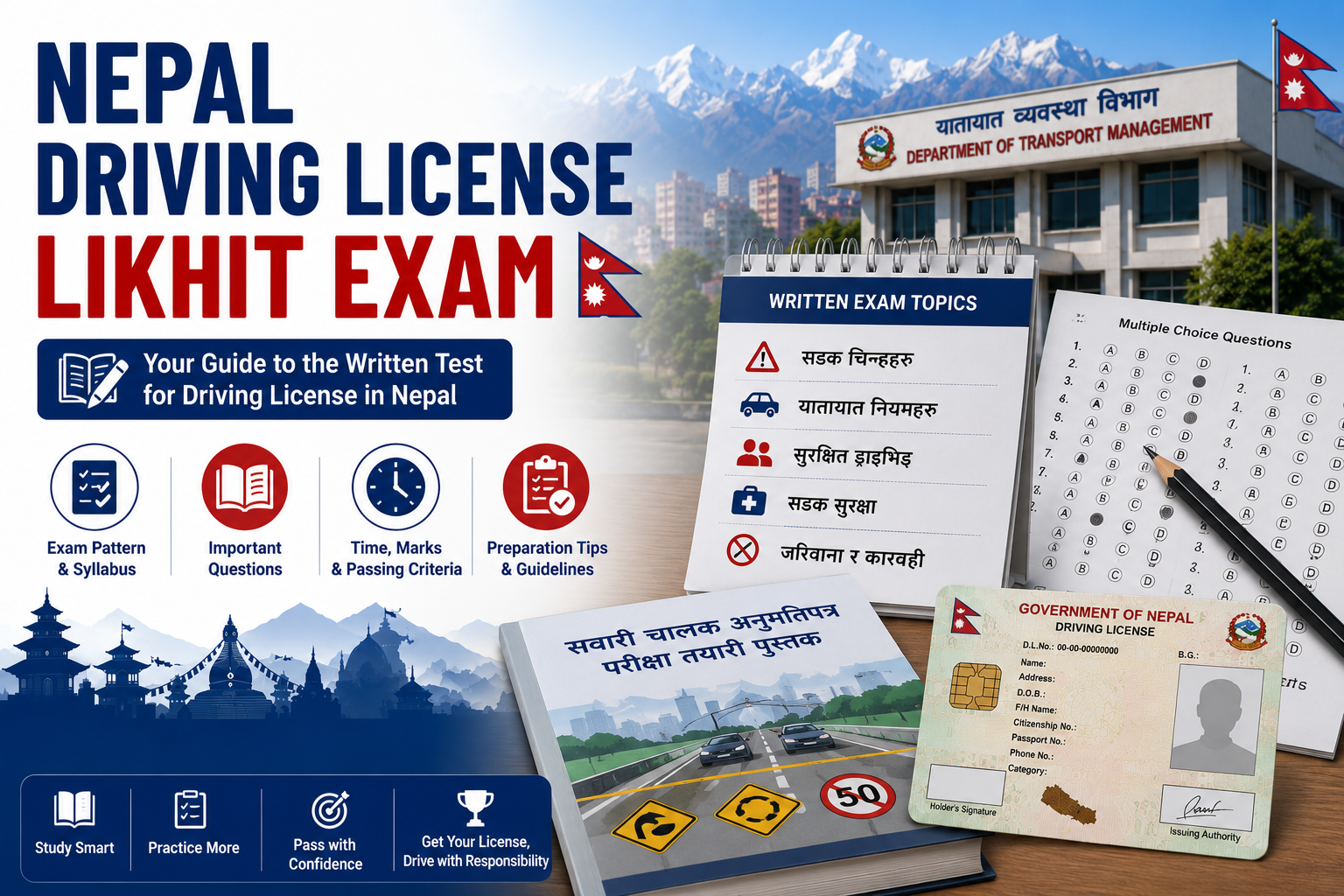
The Nepal driving license written exam — called Likhit Pariksha (लिखित परीक्षा) — is one of the two major tests you must pass before receiving your smart card. This guide covers the exam format, common question topics, passing requirements, and the most effective preparation strategies for 2026.
Likhit Exam Overview
| Detail | Information |
|---|---|
| Type | Multiple choice (MCQ) |
| Number of Questions | 25 questions (some offices give 50) |
| Duration | 20–30 minutes |
| Passing Mark | 80% (20 out of 25, or 40 out of 50) |
| Medium | Nepali language (some offices allow English) |
| Mode | Computer-based at most offices; paper-based at some rural offices |
| Negative marking | No |
What Topics Are Covered?
1. Traffic Signs and Signals (30–35% of questions)
This is the most important topic. You must recognize and understand all road signs used in Nepal, including:
- Mandatory signs (circular, red border) — speed limits, one-way, no entry
- Warning signs (triangular) — sharp curves, pedestrian crossings, school zones
- Informatory signs (rectangular) — hospital, fuel station, distance markers
- Traffic light rules — right on red, pedestrian signals, flashing amber
2. Traffic Rules and Road Laws (25–30% of questions)
- Right-of-way rules at intersections
- Overtaking rules (when allowed and when prohibited)
- Speed limits (urban: 40 km/h, highway: 60–80 km/h, school zones: 20 km/h)
- Pedestrian right-of-way
- Seatbelt and helmet laws
- Mobile phone use while driving rules
- Drunk driving penalties
3. Vehicle Knowledge (15–20% of questions)
- Basic parts of a motorcycle and car
- Checking brakes, lights, and horn before driving
- What to do if a vehicle breaks down on the road
- Safe following distance
4. Emergency and First Aid (10–15% of questions)
- What to do after an accident
- How to alert emergency services
- Basic first aid priorities
5. Environmental and Parking Rules (5–10% of questions)
- No-parking zones
- Pollution control rules
- Night driving rules
Sample Questions
Q: What does a red octagonal sign mean?
Answer: Stop completely and proceed only when safe.
Q: What is the maximum speed limit in a residential area in Nepal?
Answer: 40 km/h.
Q: You approach an intersection at the same time as another vehicle from the right. Who has the right of way?
Answer: The vehicle coming from the right has right of way.
Q: Which lane should you use for overtaking?
Answer: The right lane (as Nepal follows left-hand traffic).
Q: What is the blood alcohol limit for drivers in Nepal?
Answer: 0.05% (50mg per 100ml of blood). Professional vehicle drivers have a stricter limit of 0.03%.
How to Prepare Effectively
1. Study the Official DOTM Question Bank
DOTM publishes a question bank of approximately 500 questions from which exam questions are drawn. Study all of them — especially the traffic signs section, which most first-time failures come from.
2. Practice on Online Test Simulators
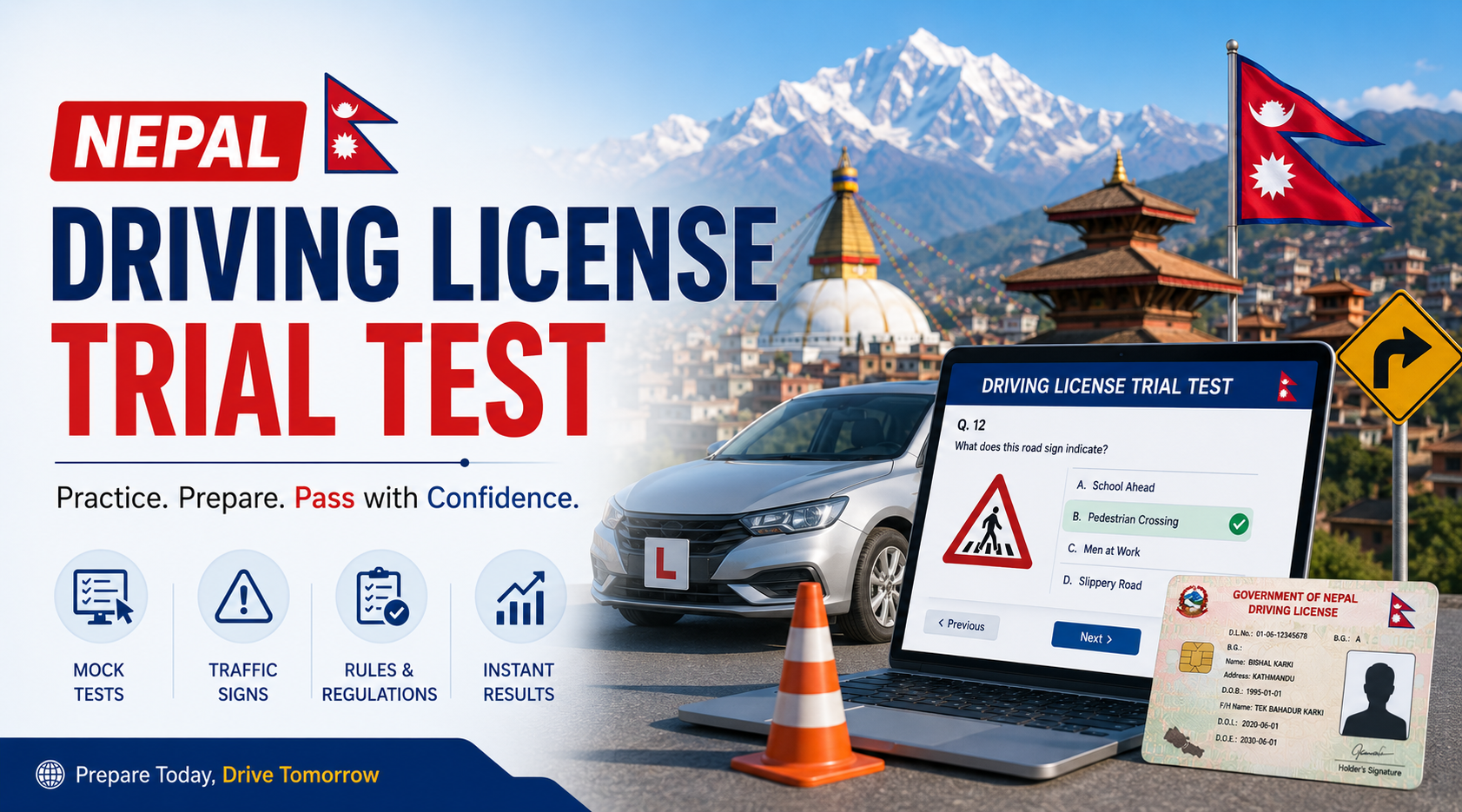
Several websites offer free Nepal Likhit exam practice tests in the same format as the real exam. Doing 3–5 practice tests before your exam significantly increases your pass rate.
3. Memorize All Road Signs Visually
Print or bookmark a visual guide to all Nepal road signs. Most exam failures happen because candidates can identify the name of a sign but cannot recognize its visual shape. Learn both.
4. Don't Guess on Speed Limits
Speed limit questions are frequently answered incorrectly. Memorize: urban areas = 40 km/h, school/hospital zones = 20 km/h, highways = 60 km/h (motorcycles) to 80 km/h (cars), Kathmandu Ring Road = 50 km/h.
What If You Fail the Likhit Exam?
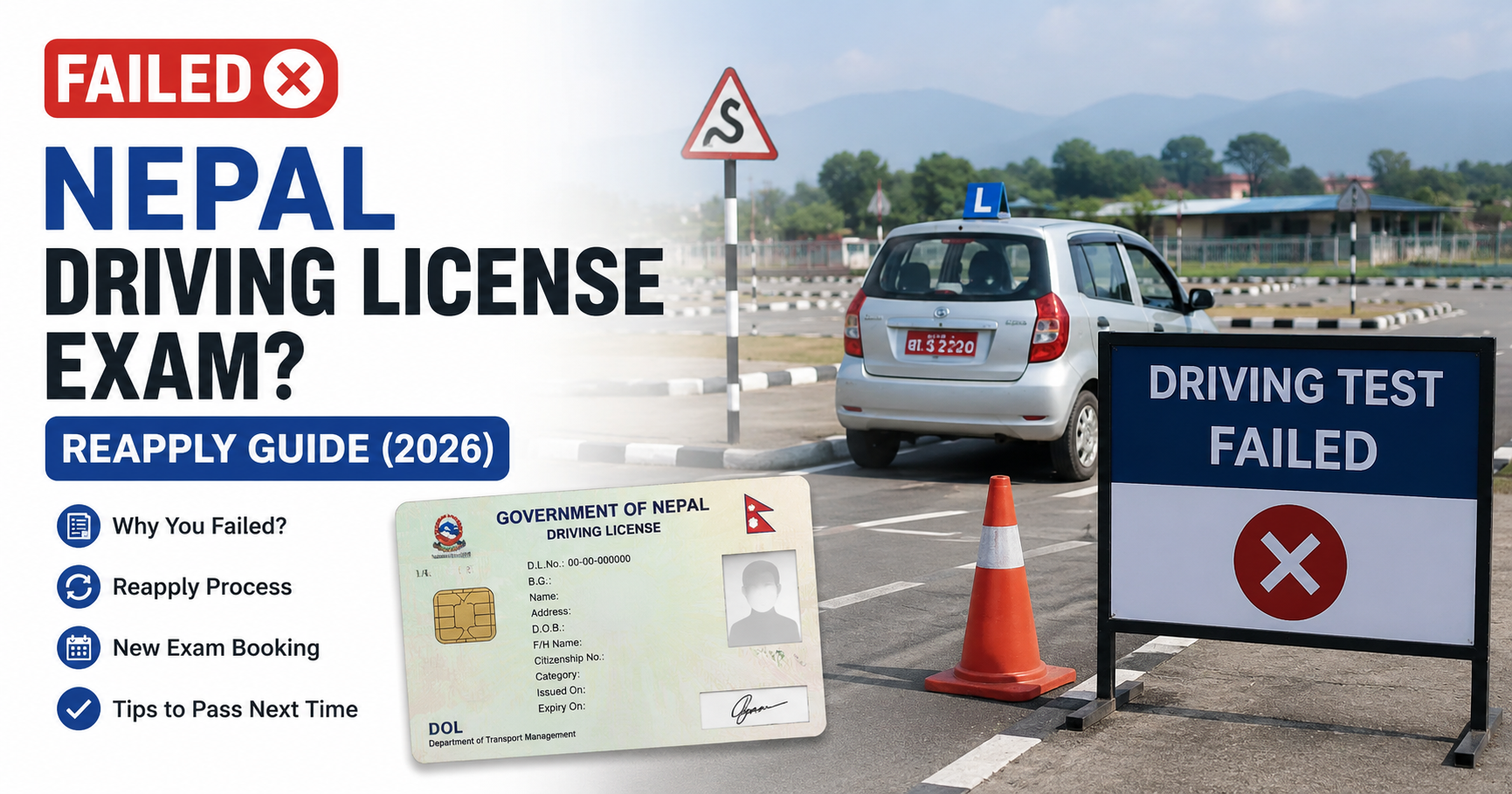
If you do not achieve 80% or above, you can retake the exam by paying a retake fee of NPR 400 and scheduling a new exam date through the DOTM portal. There is no cap on the number of retakes, but each attempt requires a new fee.
Tip: Most candidates who fail do so because of traffic signs, not road rules. Spend the majority of your preparation time on signs.
Frequently Asked Questions
Is the Likhit exam the same for Category A and Category B?
Yes. The question bank covers both motorcycle and car driving rules. The exam content is effectively the same regardless of category. If applying for both A and B, you only sit the Likhit once.
Can I bring notes or study material into the exam?
No. The exam room is monitored. No reference material is allowed.
How soon after biometrics is the exam scheduled?
Typically within 2–4 weeks of your biometric date. DOTM will notify you of the exam date — check your DOTM portal account and the SMS number you registered with.
Is there a minimum age requirement for the Likhit exam?
No separate age requirement — as long as you meet the minimum age for the category you applied for (16 for Category A, 18 for Category B).