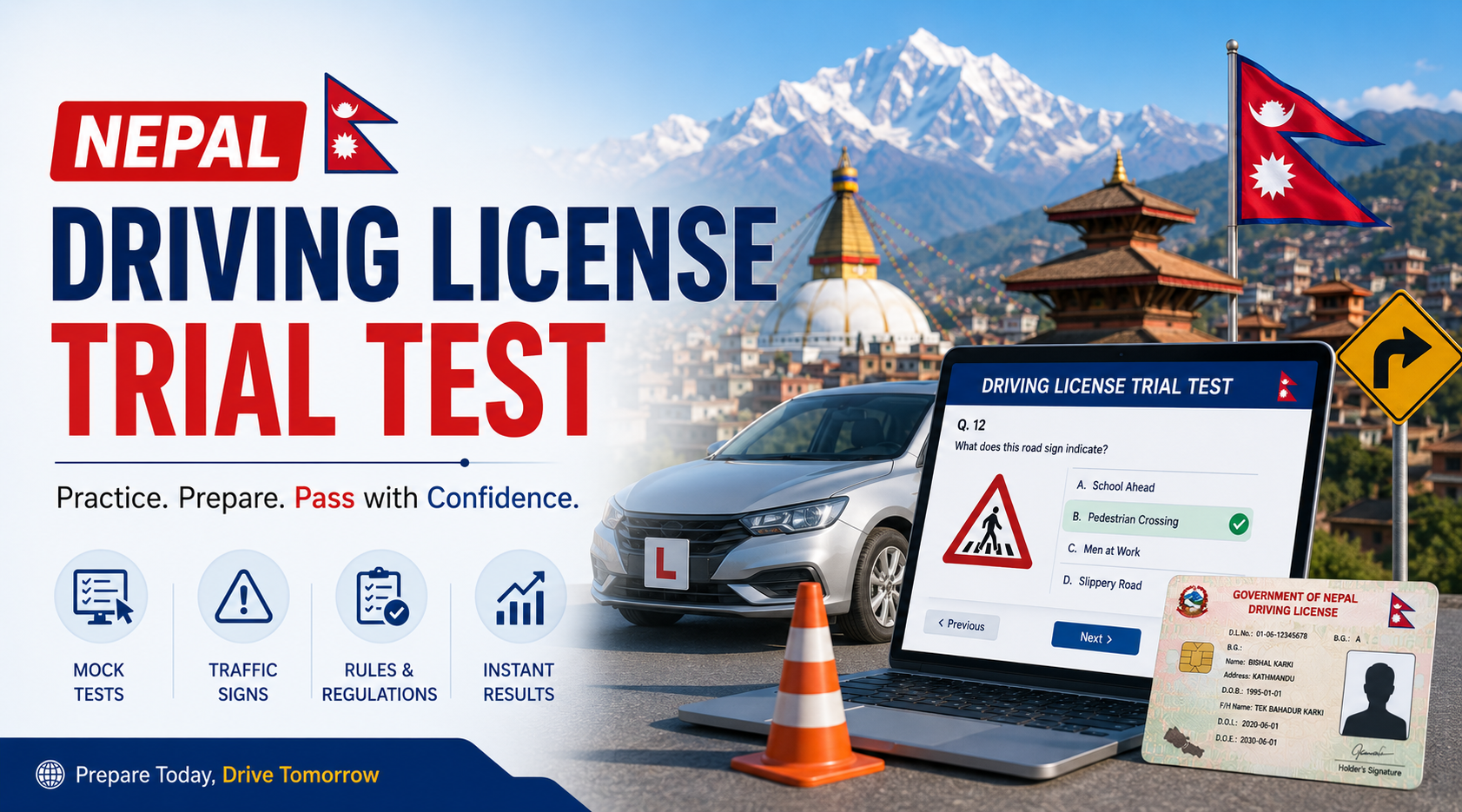
After passing the written (Likhit) exam, the final hurdle before your smart card is the trial test — Nepal's practical driving examination. For motorcycle applicants, this means navigating the famous figure-of-8 course. For car applicants, it involves a basic maneuverability test. This guide breaks down everything you need to know to pass first time.
Trial Test Overview
| Detail | Category A (Motorcycle) | Category B (Car/Jeep) |
|---|---|---|
| Test Format | Figure-of-8 (अठ अंकको कोर्स) course | Forward/reverse maneuverability |
| Duration | 2–5 minutes per attempt | 5–10 minutes per attempt |
| Passing condition | Complete course without feet touching ground | Complete maneuvers without hitting cones |
| Retake fee | NPR 400 | NPR 400 |
| Number of attempts allowed | Unlimited (each costs NPR 400) | Unlimited (each costs NPR 400) |
Understanding the Figure-of-8 Course (Category A)
The 8-figure course consists of two circles connected at a central point. You must ride your motorcycle through both loops in a continuous figure-of-8 pattern:
- The course is narrow — typically 80–90 cm wide for the track boundaries
- You must complete at least one full figure-of-8 (two loops) without stopping or putting your foot down
- Speed is controlled — going too fast is as problematic as going too slow
- The vehicle used is typically a standard 100–125cc motorcycle provided by DOTM
Step-by-Step: How to Navigate the Figure-of-8
1. Start Position
Position your motorcycle at the entry point. Keep both feet on the pegs. Do not start until the examiner signals you to begin.
2. Enter the First Loop
Enter slowly and smoothly. Keep your speed consistent — aim for a walking pace. Do not brake suddenly; use gentle braking throughout the course.
3. The Central Crossing Point
This is where most candidates fail. As you cross the center figure-of-8 junction, control your lean angle carefully. Too much speed causes you to go wide and leave the track.
4. Complete the Second Loop
Maintain the same pace. Look ahead to where you are going, not down at your wheels. Your handlebars follow your eyes.
5. Exit the Course
Exit cleanly and stop within the designated stopping zone. Do not put your foot down until fully stopped.
Tips That Directly Improve Your Pass Rate
Clutch Control Is Everything
For 100–125cc bikes, the key to low-speed control is the friction zone — keep the clutch slightly engaged (half-released) throughout the course. This gives you power without speed and prevents stalling.
Look Where You Want to Go
This is the single most important technique. Your body and motorcycle naturally follow your line of sight. Look at the apex of each turn, not at the track boundaries. Candidates who look at the ground in front of their wheel consistently drift off course.
Use Rear Brake Only
At low speeds, use only the rear brake for speed control. Front braking at low speed causes the bike to wobble and fall. Keep your right foot covering the rear brake pedal throughout the course.
Practice the Course Before Your Test
Many DOTM offices allow candidates to observe and practice the course before their official attempt. Arrive early on your exam day and watch a few attempts. Note where candidates typically lose control — usually the central crossing point.
Use a Relaxed Grip
Gripping the handlebars too tightly causes jerky steering. Loose, relaxed hands with firm wrists allow smooth navigation. Shake out your hands before mounting if you feel tense.
Category B Trial Test (Car/Jeep)
For car applicants, the trial test typically involves:
- Forward parking: Driving into a designated parking bay between cones
- Reverse parking or reverse bay: Reversing into a bay without hitting cone markers
- Gradient stop and start: Stopping on a slope and moving forward without rolling back (hill start)
The car is usually a small manual hatchback provided by DOTM. If you only drive automatic vehicles in real life, practice manual shifting before your test.
Most Common Reasons for Failing
| Mistake | Category | Prevention |
|---|---|---|
| Foot touching ground mid-course | A (motorcycle) | Clutch friction zone, slow and smooth |
| Going too wide at center crossing | A (motorcycle) | Reduce speed before crossing, look ahead |
| Stalling the engine | Both | Practice clutch-throttle balance |
| Hitting cones during parking | B (car) | Use reference points on bonnet/mirrors |
| Rolling back on hill start | B (car) | Handbrake method: hold brake, find bite point, release handbrake |
How to Retake If You Fail
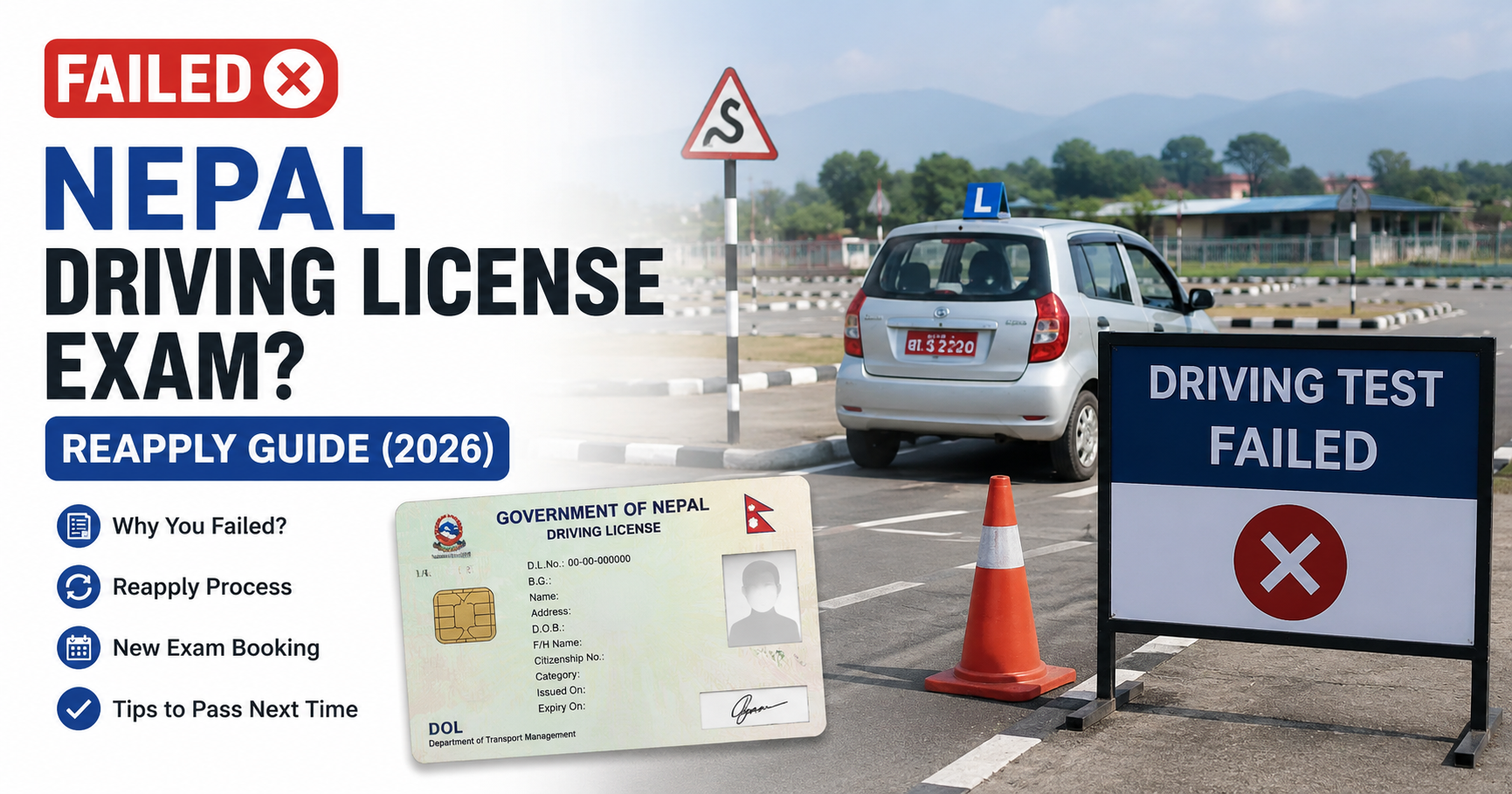
If you fail your trial test, pay NPR 400 through the DOTM portal and book a new trial date. There is no penalty or waiting period between retakes beyond the scheduling time (typically 1–3 weeks). Many candidates pass on their second or third attempt after specific targeted practice.
Frequently Asked Questions
Can I use my own motorcycle for the trial test?
At most DOTM offices, DOTM provides the vehicle. Some offices allow personal vehicles. Confirm with your specific transport office before your test day.
Is there a dress code for the trial test?
No formal dress code, but proper footwear is essential — open-toed shoes or slippers are not appropriate for operating a motorcycle. Wear closed shoes with good grip.
Do I need a helmet for the trial?
Yes. DOTM offices typically provide helmets for the trial, but you are also welcome to bring your own. A properly fitted helmet is mandatory.
What if I stall the motorcycle during the test?
One stall is typically not an automatic fail if you restart and complete the course. Multiple stalls or putting your foot down to stabilize after a stall will result in a fail. Restart calmly and proceed.